Internal Thread Minor Dia for Plug Gauge Design
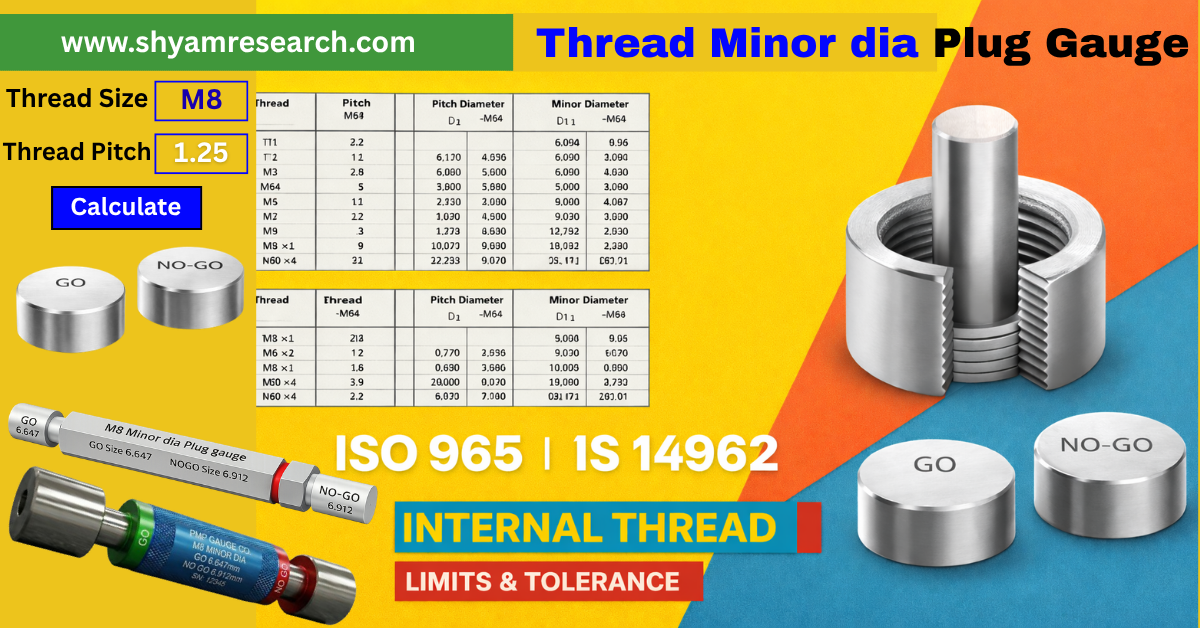
Note: If pitch is not mentioned → it is Standard Pitch. If the pitch size is not available in the dropdown, it means it is a standard pitch size. You can verify the standard pitch size from written below blogs.
ISO 965-2 & IS 14962-2 Internal Threads – Minor Diameter & Plain Plug Gauge
In thread inspection, internal threads (nuts) are one of the most critical features to control. Among all parameters, the minor diameter (D1) plays a key role in ensuring proper thread strength and assembly.
As per ISO 965-2:1998 & IS 14962-2:2001, limits for internal threads are clearly defined, and based on these limits, we can design Plain Plug Gauges for accurate minor diameter checking.
Standard Pitch Size List
Metric Thread Standard Pitch Table
| Thread | Pitch | Thread | Pitch |
|---|---|---|---|
| M1 | 0.25 | M18 | 2.5 |
| M1.2 | 0.25 | M20 | 2.5 |
| M1.4 | 0.3 | M22 | 2.5 |
| M1.6 | 0.35 | M24 | 3.0 |
| M1.8 | 0.35 | M27 | 3.0 |
| M2 | 0.4 | M30 | 3.5 |
| M2.5 | 0.45 | M33 | 3.5 |
| M3 | 0.5 | M36 | 4.0 |
| M4 | 0.7 | M39 | 4.0 |
| M5 | 0.8 | M42 | 4.5 |
| M6 | 1.0 | M45 | 4.5 |
| M8 | 1.25 | M48 | 5.0 |
| M10 | 1.5 | M52 | 5.0 |
| M12 | 1.75 | M56 | 5.5 |
| M14 | 2.0 | M60 | 5.5 |
| M16 | 2.0 | M64 | 6.0 |
What ISO 965-2 & IS 14962-2 Says About Internal Threads
ISO 965-2 defines:
- Limits of Pitch Diameter (D2)
- Limits of Minor Diameter (D1)
- Applicable for:
- Coarse thread series
- Fine thread series
- Medium tolerance class
Internal Thread Parameters
For internal threads (Nut), 2 important dimensions are:
- Pitch Diameter (D2)
- Controls fit between bolt & nut
- Checked by Thread Plug Gauge (GO / NO-GO)
- Minor Diameter (D1)
- Controls strength of thread
- Checked by Plain Plug Gauge
- How to decide Plain Plug Gauge GO & NOGO size – You can check from above calculator
Internal Thread Limits
Example for M6 Internal Thread:
- Pitch Diameter (D2):
- Max: 5.500 mm
- Min: 5.350 mm
- Minor Diameter (D1):
- Max: 5.153 mm
- Min: 4.917 mm
👉 These values are the base for gauge design.
Design of Plain Plug Gauge (Minor Diameter)
Now the main question
👉 How to Make Plain Plug Gauge for Internal Thread?
Step 1: Take Minor Diameter Limits
From ISO table: which calculator given above – select the Size of Thread
Example: M6 thread
- D1 (Max) = 5.153 mm
- D1 (Min) = 4.917 mm
Step 2: Understand GO & NO-GO Concept
Go Size – Check Minimum Size
NO SIZE – Check Maximum Size
Step 3: Design Formula
GO Plug Gauge Size:
👉 GO = Minimum Minor Diameter
Note – For M6 Thread Minor dia will be GO = 4.917 mm
NO-GO Plug Gauge Size:
👉 NO-GO = Maximum Minor Diameter
Note – For M6 Thread Minor dia will be NOGO = 5.513 mm
Why Minor Diameter Checking is Important?
Minor diameter checking is extremely important in internal threads because it allows fast, reliable, and 100% inspection at the shop floor level.
In practical manufacturing conditions, it is not feasible for operators to check every part using a thread plug gauge, as it takes more time and requires careful handling. To solve this problem, a plain plug gauge (minor diameter gauge) is used.
✅ Key Reasons:
- 100% Inspection Possible
- Operators can quickly check every part using a minor diameter plug gauge without slowing down production.
- Faster Than Thread Plug Gauge
- Plain plug gauges are simple and easy to use, enabling quick decision-making on the shop floor.
- Prevents Customer Rejection
- By ensuring minor diameter is within limits, defective threads are identified early, so no rejected parts reach the customer.
- Indirect Thread Quality Check
- If the minor diameter is out of limit:
- The thread is either too tight or too loose
- This directly affects thread functionality
- If the minor diameter is out of limit:
👉 Important Practical Rule:
If Minor Diameter Plug Gauge fails → Thread is also rejected
Standard Pitch Size
Conclusion
ISO 965-2 provides clear limits for internal thread dimensions, and using these limits:
✔ We can design accurate Plain Plug Gauges
✔ Ensure proper minor diameter control
✔ Improve thread strength and quality